
California Public Records Act
The California Public Records Act lives in Government Code section 7920.000 et seq.. The act sets out the public's right to access records held by state and local public agencies. It applies to county departments like the Sheriff, the District Attorney, the Public Defender, and the Clerk-Recorder, and to most boards and special districts within the county. The general rule under Government Code section 7922.000 favors disclosure unless the public interest in nondisclosure clearly outweighs disclosure.
The California Attorney General publishes a public summary of the act and the public's rights under it. The summary is a useful first read for anyone who has not filed a CPRA request before.
Lead-in source: see the California Attorney General CPRA summary for a plain-language overview.
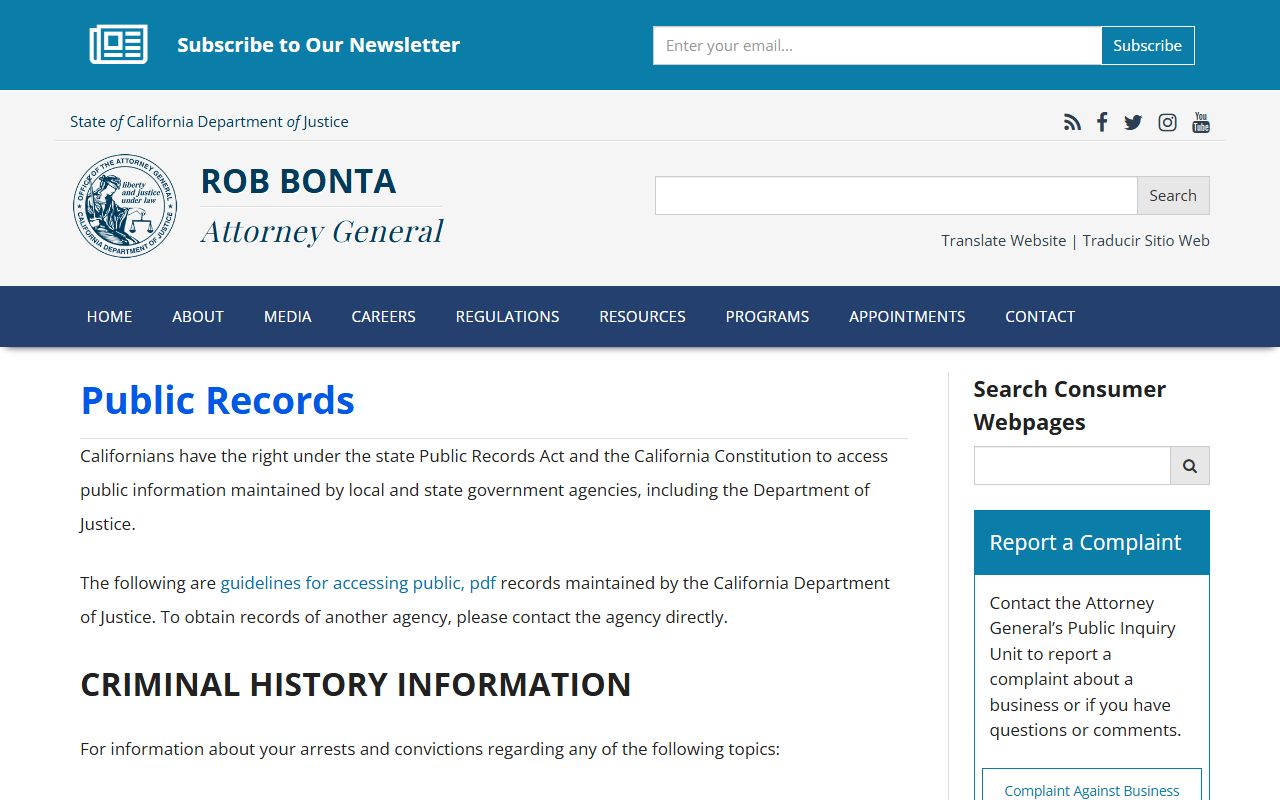
The page covers the act's scope, the exemptions list, fee rules, and what to do if a request is denied. State agencies and local agencies share the same basic framework, with a few rules unique to each.
Anyone may file a CPRA request. There is no residency rule. A requester does not have to give a reason. Records can be inspected for free at the agency or copied for the cost of duplication. Records in electronic format must be provided in that format if the agency keeps them that way and a requester asks for it.
CPRA Records vs. Court Records
Court files are not CPRA records. Records held by the Superior Court of California, County of Santa Barbara fall under California Rules of Court rule 2.503 and related rules. The court has its own copy fees, its own records request form, and its own remote display limits. A public records request that lands at the court's Records department will be answered under court rules, not under the CPRA.
The rule splits along these lines. CPRA covers executive and local agency records. Court rules cover court filings, dockets, exhibits, transcripts, and orders. Police investigative files held by the Sheriff are CPRA records, with the criminal-records access carveouts in Penal Code section 13300. Court files with criminal cases are court records under CRC 2.503. The same arrest may show up in two places under two different rules.
What the Santa Barbara Clerk-Recorder Holds
The County Clerk-Recorder, led by Joseph E. Holland, is not the same office as the court clerk. The Clerk-Recorder holds recorded documents and most county-level vital records. The Hall of Records at 1100 Anacapa Street in Santa Barbara is the main public counter, with a North County office at 511 Lakeside Parkway, Suite 115, in Santa Maria. Phone 805-568-2250.
Lead-in source: see the Clerk-Recorder home page.
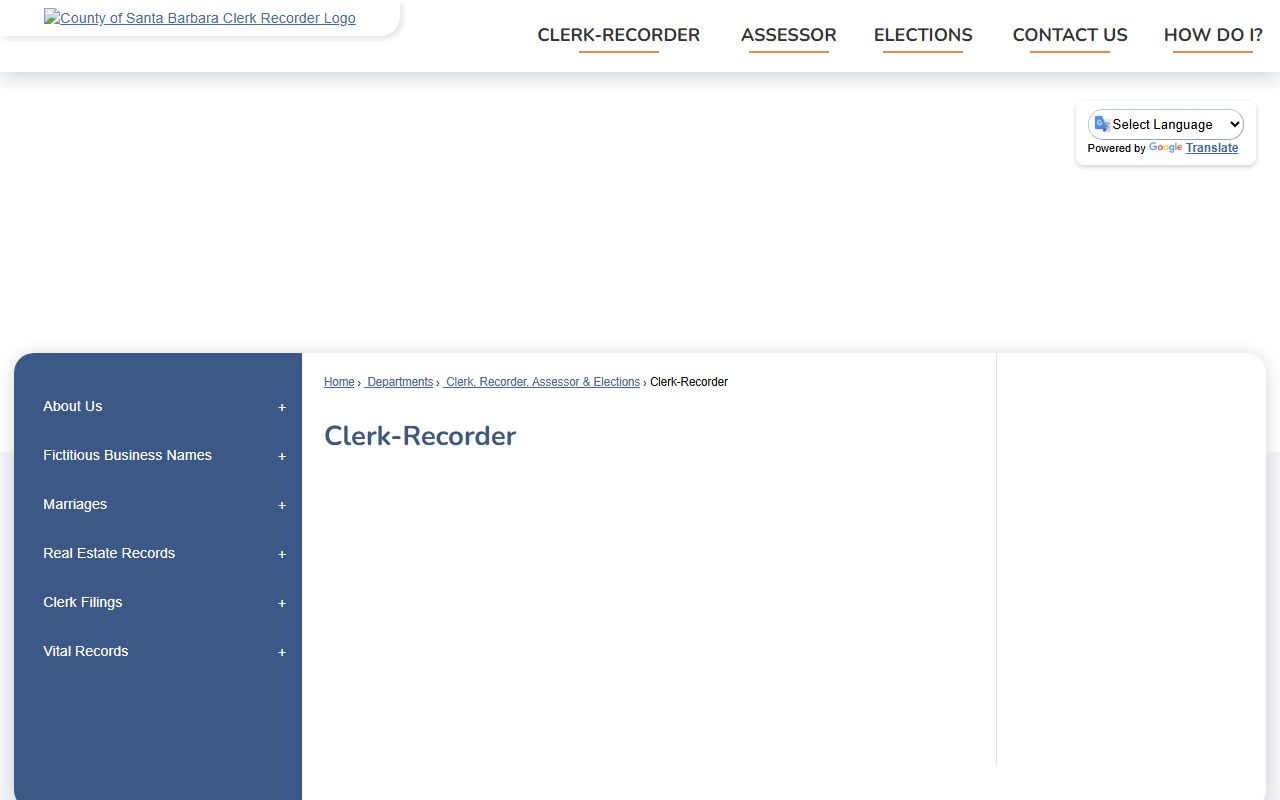
The page links to the office's main service areas and to the online real estate records index at records.sbcrecorder.com.
- Recorded documents like deeds, deeds of trust, liens, releases, and mechanics' liens
- Real estate records index, searchable online for general public use
- Marriage licenses and marriage certificates, both public and confidential
- Birth certificates and death certificates for events recorded in the county
- Fictitious business name statements and county clerk filings
- Notary public oaths and bonds filed at the county level
The office is clear about what it does not handle. The Clerk-Recorder does not provide passports, divorce filings, court records, or traffic tickets. Those go to other offices or to the Superior Court.
How to File a Santa Barbara Public Records Request
Each county department handles its own CPRA requests. There is no single county-wide intake form. A clear, focused request gets a faster response than a broad one. Pick the right office before you write the request. The list below covers the standard CPRA workflow for a Santa Barbara County agency record.
- Pick the right agency. Sheriff records go to the Sheriff. DA charging records go to the District Attorney. Clerk-Recorder index records go to the Clerk-Recorder. Court files go to the Superior Court under CRC 2.503, not CPRA.
- Describe the records as specifically as you can. Include dates, names, case numbers, document types, and any other identifier. A request for "all records about X" is harder to answer than a request for "the use-of-force report from incident 24-12345 dated June 1, 2025."
- Pick a delivery format. Ask for electronic copies where they exist. Inspection at the agency is free; copies cost the duplication fee.
- Submit the request. Most county agencies accept written requests by mail or email. Some have an online portal. The Sheriff and the District Attorney each list a CPRA address on their websites.
- Wait for the agency's first response. Government Code section 7922.535 generally requires a response within 10 calendar days saying whether the agency has the records.
- Pay any duplication fees if the agency provides copies. Inspection on site is free.
- If denied, ask the agency to point you to the exemption it relied on. If you still disagree, you can sue under the CPRA or work through the Attorney General's office, which offers public guidance.
Government Code section 7922.535 allows the agency to extend the initial response by up to 14 days for unusual circumstances. The extension does not waive the response itself; the agency must still respond within the extended window.
Public Records Request Form Fields
Most county CPRA requests use the same basic field set. The court's records request, while not a CPRA form, uses a similar field list. The table below combines the standard CPRA fields with the court's own copy request fields so requesters can use the same template for either path.
| Field / item | Type | Required | Notes |
|---|---|---|---|
| Requester name and contact | text | Yes | Needed for the agency to respond and to deliver records. |
| Case number (court records) | text | Strongly recommended | Court says case number is the easiest way to find a record. |
| Party names (court records) | text | If case number is unknown | Court does not confirm personal identifying info by phone or email. |
| Description of records | text/checkbox | Yes | Be specific. Date range, document type, and any case or incident number help a lot. |
| Date range | date range | No | A range cuts the search time and the chance of a fee for searches over 10 minutes. |
| Delivery method | choice | Yes | Pickup, mail, or email. Certified court copies cannot be emailed. |
| Format preference | choice | No | Paper or electronic. Agencies must provide records in their kept format when reasonable. |
| Payment method | check/cash/card/invoice | Conditional | Do not send credit card data by email or phone. |
| Self-addressed stamped envelope | physical item | If mailed copies | Skip it and the court adds postage to the bill. |
Response Timelines Under the CPRA
Government Code section 7922.535 sets the response clock at 10 calendar days from the date the agency gets the request. The agency must say whether it has records that match the request, whether any are exempt, and when records will be made available. The agency can extend the response window by up to 14 days for unusual circumstances. Production of the records themselves is on a separate timeline, set out in the agency's response.
If the agency refuses to provide records, the requester can ask for the legal basis for the denial. The agency must list the exemption it relied on. From there, the requester can sue under Government Code section 7923.000 et seq. to compel disclosure, or work through advocacy from the California Attorney General's public records resources.
Santa Barbara CPRA Agencies
The three biggest CPRA sources for criminal-justice records in the county are the Sheriff, the District Attorney, and the Public Defender. Each agency has its own intake page, its own fee schedule, and its own exemption list. Use the agency's own page for the most current contact.
The Santa Barbara County Sheriff's Office handles use-of-force records, daily activity logs, and many incident-level requests under Penal Code section 832.7 as amended by SB 1421 and SB 16.
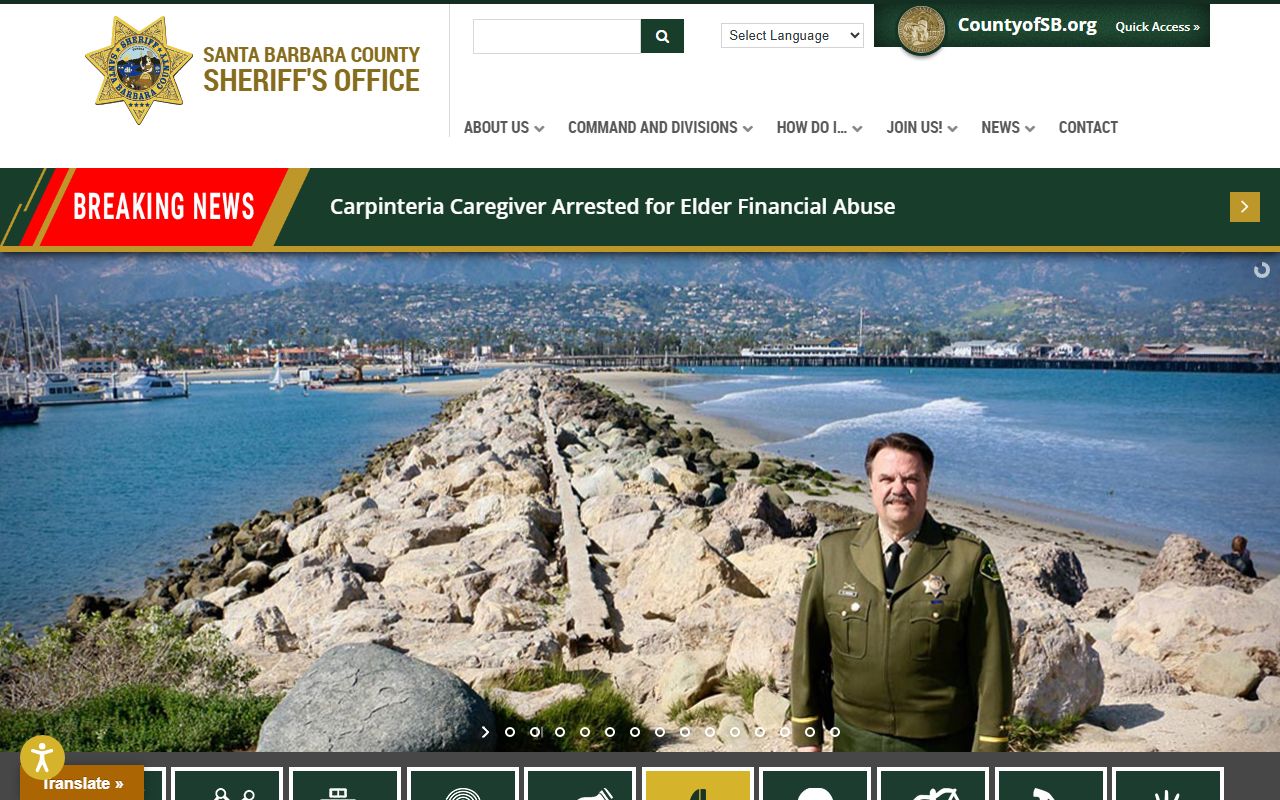
The Sheriff posts a separate CPRA portal that handles intake. The office is led by Sheriff Bill Brown. Booking and inmate inquiries are routed to the jail phone numbers when the Who's In Custody database is offline.
The Santa Barbara County District Attorney handles charging files, victim services records, and certain post-conviction records.
The DA's office posts its CPRA intake address on the public site. Charging documents that have been filed with the court are court records under CRC 2.503, not DA records.
The Santa Barbara County Public Defender represents indigent defendants and holds case files that are generally privileged client records.
Public Defender client files are not CPRA records. Office-wide policy, budget, and aggregate statistical records may be.
Public Records Fees in Santa Barbara County
CPRA fees are limited to the direct cost of duplication. The agency cannot charge for the staff time spent locating records or for the time spent reviewing records for exemption claims. The court has its own fee schedule under Government Code sections 70626 and 70627. The table below shows the court's published fees, which apply when the request is for a court record rather than a CPRA record.
| Item | Amount |
|---|---|
| Court copy per page | $0.50, Gov. Code section 70627(a) |
| Certification of court document | $40 plus $0.50 per page, Gov. Code section 70626(a)(4) |
| Certified divorce judgment | $15 plus $0.50 per page, Gov. Code section 70674 |
| Search over 10 minutes | $15, Gov. Code section 70627(c) |
| North County fax copies | $1 per page |
| Invoice cost recovery | $1, Gov. Code section 68150(l) and CRC 2.506 |
| Credit-card surcharge | 2.9% plus $0.60 for Visa, Mastercard, Discover |
| CPRA copy fee, county departments | Direct cost of duplication; set by each agency |
Government Code section 7922.575 allows electronic record requesters to be charged the cost of producing the record in the requested format, in some cases including programming costs, but not the cost of staff search time.
Records That Are Not Public
The CPRA lists many categories of records that are exempt from disclosure. Some of the common ones are personnel files, draft documents not retained in the ordinary course, investigation records during an active probe, attorney-client work product, social security numbers, and some technical security records. Juvenile records under Welfare and Institutions Code section 827 are restricted. Adoption records under Family Code section 9200 are sealed. Mental health and LPS records are restricted by statute and by CRC 2.503.
Records that have been sealed by court order under California Rules of Court rules 2.550 and 2.551 stay off the public file. The Information Practices Act, Civil Code section 1798.24, governs state agency disclosure of personal information and limits redisclosure.
Third-Party Aggregator Caution
Several private websites pull and resell Santa Barbara County records. Many of those sites repackage stale data, add a fee, and post results without the official agency context. Use the official source first. The Sheriff posts current jail and custody pages. The District Attorney posts its own contact. The Clerk-Recorder runs records.sbcrecorder.com directly. The Superior Court runs the Odyssey portals. A record pulled from the originating agency is the record. A record pulled from a third party may be partial, out of date, or wrong.