
Getting a Marriage License in Santa Barbara County
The Santa Barbara County Clerk-Recorder, led by Joseph E. Holland, issues every marriage license used in the county. The office runs two public counters. The main one is the Hall of Records at 1100 Anacapa Street in Santa Barbara. The second is at 511 Lakeside Parkway, Suite 115, in Santa Maria. Both share one phone line at 805-568-2250 and the same hours: Monday through Friday, 8:00 a.m. to 4:30 p.m. The office tells the public to arrive no later than 4:00 p.m. Same-day service is not a sure thing.
The Clerk-Recorder is the only place in the county that issues a marriage license. The Superior Court does not handle this part of the process at all. Anyone who wants to get married in California can pick any county to apply, then use that license anywhere in the state. The license stays active for 90 days from the date of issue. Both people must show up together to finish the application and sign in front of a clerk. A current government-issued photo ID is the main requirement. There is no blood test rule, and no birth certificate is needed.
The clerk's office reports a recent jump in volume. The Clerk-Recorder issued more than 6,000 marriage licenses in 2025, up from around 4,000 per year before COVID. That makes lines real, so the office pushes the online application step before any in-person visit. The form goes through the secure portal at records.sbcrecorder.com. Bring the confirmation, both IDs, and your method of payment to the appointment.
How to Apply for a Santa Barbara Marriage License
Most of the work happens before the office visit. The Apply for a Marriage License page walks couples through the steps and links to the online intake form. The marriage license application process page is the best place to start, since it explains the public vs. confidential license choice, the ID rule, and the 90-day window. Couples should plan the trip to the Clerk-Recorder for a date well before the ceremony, since the license is valid for 90 days and cannot be cut short or extended.
The Clerk-Recorder office publishes a screenshot of the marriage license application process and FAQs page that walks couples through what to expect at the counter.
Lead-in source: see the Apply for a Marriage License page for the full process.
The page covers the online intake step, the in-person ID check, and how to fix typos after the license is issued. Use it as the official reference if you have a question that does not show up in the step list below.
- Submit the online application through records.sbcrecorder.com before going to the office. The system saves your data and gives you a tracking step you can finish later.
- Choose between a public license and a confidential license. A public license is on file as a public record. A confidential license has access rules under the California Family Code and is open only to the spouses or by court order.
- Book a visit at the Hall of Records in Santa Barbara or the Lakeside Parkway office in Santa Maria. Both parties must come at the same time. Plan to arrive before 4:00 p.m.
- Bring a current government-issued photo ID for each person. The clerk needs to verify ID in person. No blood test is needed. No birth certificate is needed.
- Pay the license fee at the counter. The Clerk-Recorder takes cash, check, or card. Confirm fee amounts on the Marriage Fees page before the visit.
- Sign in front of the clerk. The clerk issues the license on the spot. The license is good for 90 days from that date.
- Hold the ceremony within 90 days. Have the officiant return the signed license to the Clerk-Recorder. The office records the marriage and mails the certificate later.
If the license expires before the ceremony, the couple has to apply again and pay the fee a second time. The office cannot extend a license past 90 days. The Clerk-Recorder also reminds couples that California licenses can be used in any county in the state, not just the issuing one.
Marriage License Application Fields
The intake form covers both parties plus a few choices about the license type and the public record. The list below tracks the fields the Clerk-Recorder asks for at the counter and on the online intake form. Some dynamic fields on the secure portal are not fully visible from outside the session, so confirm any odd field with a clerk before the visit.
| Field | Required | Notes |
|---|---|---|
| Online application start | Yes | Submitted at records.sbcrecorder.com before the office visit. |
| Party 1 full legal name | Yes | Match the name on the photo ID; spelling errors after issue need a correction request. |
| Party 1 date of birth | Yes | Used to verify legal age and check minor-marriage rules. |
| Party 1 mailing address | Yes | Address is part of the application record. |
| Party 2 full legal name | Yes | Same rule as Party 1; both names appear on the issued license. |
| Party 2 date of birth | Yes | Both parties must be at least 18, or a court order is needed for underage marriage. |
| Party 2 mailing address | Yes | Used for record entry and any mailed certificate. |
| Government photo ID | Yes | Driver license, passport, or military ID; must be current and shown in person. |
| Prior marriages | Yes | Date the prior marriage ended; if recently divorced, bring a copy of the judgment. |
| Public or confidential license | Yes | Public goes on the index; confidential is restricted under state law. |
| Officiant information | No at apply | Filled in after the ceremony when the signed license is returned. |
| Witness information | Conditional | A public license needs at least one witness; a confidential license needs no witness. |
The Clerk-Recorder publishes the rules in plain English on the Marriage License Requirements page. That page covers ID, age, prior marriages, and what to do if a name on the ID does not match the name a person wants to use after the marriage.
Lead-in source: the Marriage License Requirements page from the county.
That page is the right second stop after the online intake. It lays out the rules the clerk will check at the counter.
Santa Barbara County Marriage and Divorce Fees
Two fee sets apply to marriage and divorce work in the county. The Clerk-Recorder sets fees for licenses and certified marriage certificate copies on the Marriage Fees page. The Superior Court sets fees for divorce filing and certified divorce judgments. Plan the budget around both. A typical run, license plus a few certified copies plus a certified divorce judgment, can hit several hundred dollars when copies stack up.
Confirm current rates on the Marriage Fees page, which the Clerk-Recorder updates when state law changes.
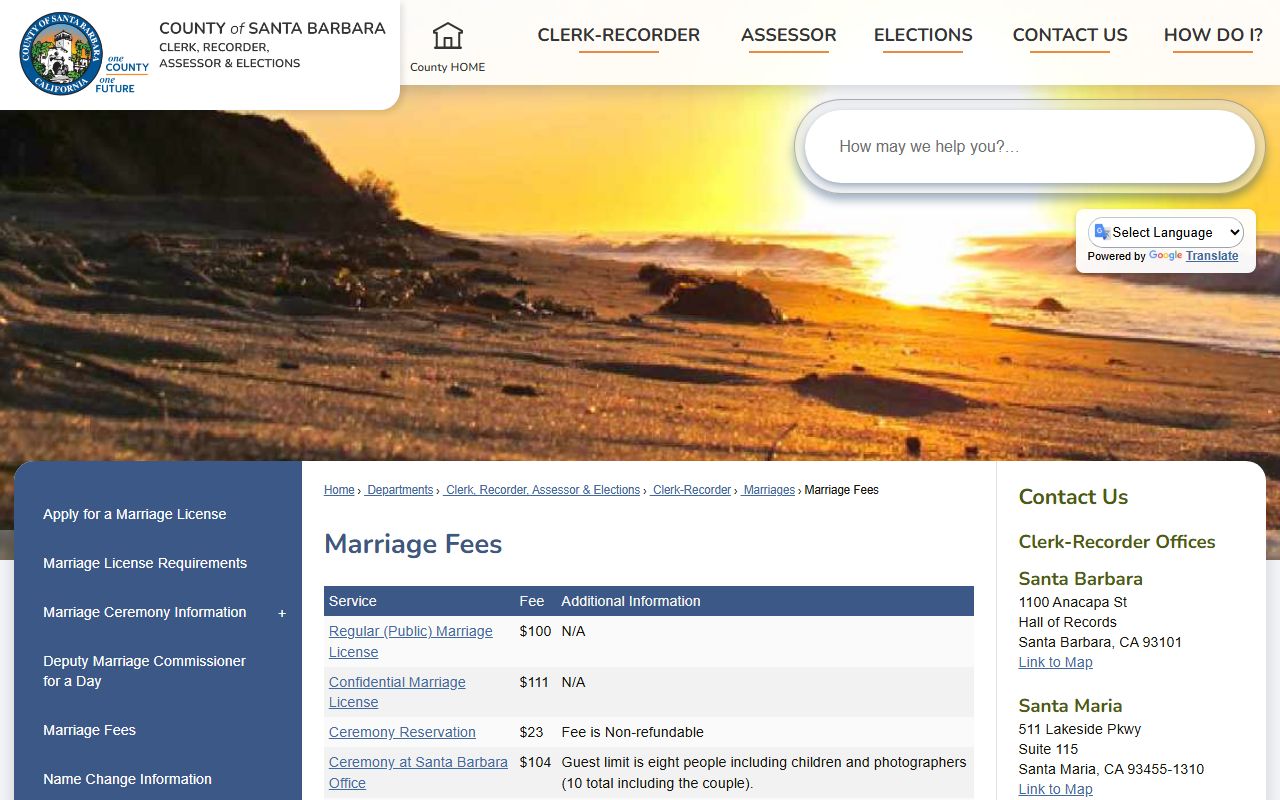
The page also explains the card surcharge and the rules for fee waivers on certain certified copies, like military returns and veteran services.
| Item | Amount |
|---|---|
| Court copy per page | $0.50, Gov. Code section 70627(a) |
| Certified divorce judgment | $15 plus $0.50 per page, Gov. Code section 70674 |
| Certification of court document | $40 plus $0.50 per page, Gov. Code section 70626(a)(4) |
| Court search over 10 minutes | $15, Gov. Code section 70627(c) |
| North County fax copies | $1 per page |
| Invoice cost recovery | $1, Gov. Code section 68150(l) and CRC 2.506 |
| Credit-card surcharge | 2.9% plus $0.60 for Visa, Mastercard, Discover |
| Marriage license and certified copies | See current Clerk-Recorder Marriage Fees page |
The certified divorce judgment line is the one most people ask about. The Superior Court charges $15 for the certification plus the standard $0.50 per page for the judgment itself. Add postage if the records office has to mail it.
Marriage License vs. Marriage Certificate
People often use the two terms as if they meant the same thing. They do not. A marriage license is the permit the Clerk-Recorder issues before the wedding. It lets the couple legally marry. A marriage certificate is the proof, signed by the officiant after the ceremony and recorded by the Clerk-Recorder. The certificate is what banks, immigration officers, name-change clerks, and Social Security ask for. Couples can order certified copies of the certificate from the Clerk-Recorder after the ceremony is recorded.
The Clerk-Recorder also runs the Marriage Records page, where the public can order copies of a recorded marriage certificate from a Santa Barbara County wedding.
That page covers the ID rules for certified copies under Health and Safety Code section 103526, the cost, and how long the office takes to mail one out. Confidential marriage certificates can only be ordered by the spouses or by a court order.
Public vs. Confidential Marriage License
California gives couples two license types. Each one has its own access rules. The public license is the default. It enters the public marriage index. Anyone can request a non-certified copy of the index entry. A confidential license is set up for couples who are already living together. It does not need a witness, and the certificate is sealed from public view. Access to a confidential record is limited to the spouses or to a person with a court order.
The choice is made on the application form. The Clerk-Recorder cannot switch a confidential license to a public one after issue. Many couples pick the confidential type for privacy reasons. The certified copy fee is the same either way.
Santa Barbara County Divorce Records
Divorce records are not at the Clerk-Recorder. They are court records, held by the Superior Court of California, County of Santa Barbara. The Clerk-Recorder page says so in plain text: the office does not provide divorce filings or court records. So a Santa Barbara County divorce records search starts at the court's records department, not the Hall of Records counter. The court runs records windows at the Figueroa Division in Santa Barbara and the Cook Division in Santa Maria.
Most divorce case data can be looked up through the court's Odyssey portals. The general portal lives at portal.sbcourts.org/CASBPORTAL. The civil-only portal at portal.sbcourts.org/CASBCIVILPORTAL covers civil dockets with remote document access where California Rules of Court rule 2.503(b) allows it. Many family law documents have access limits under CRC 2.503 even when the case itself is public. Sealed parts of a family law file, like income disclosures or addresses for victims of abuse, stay off the public portal.
The court offers a divorce and legal separation self-help page that walks litigants through filing and follow-up steps.
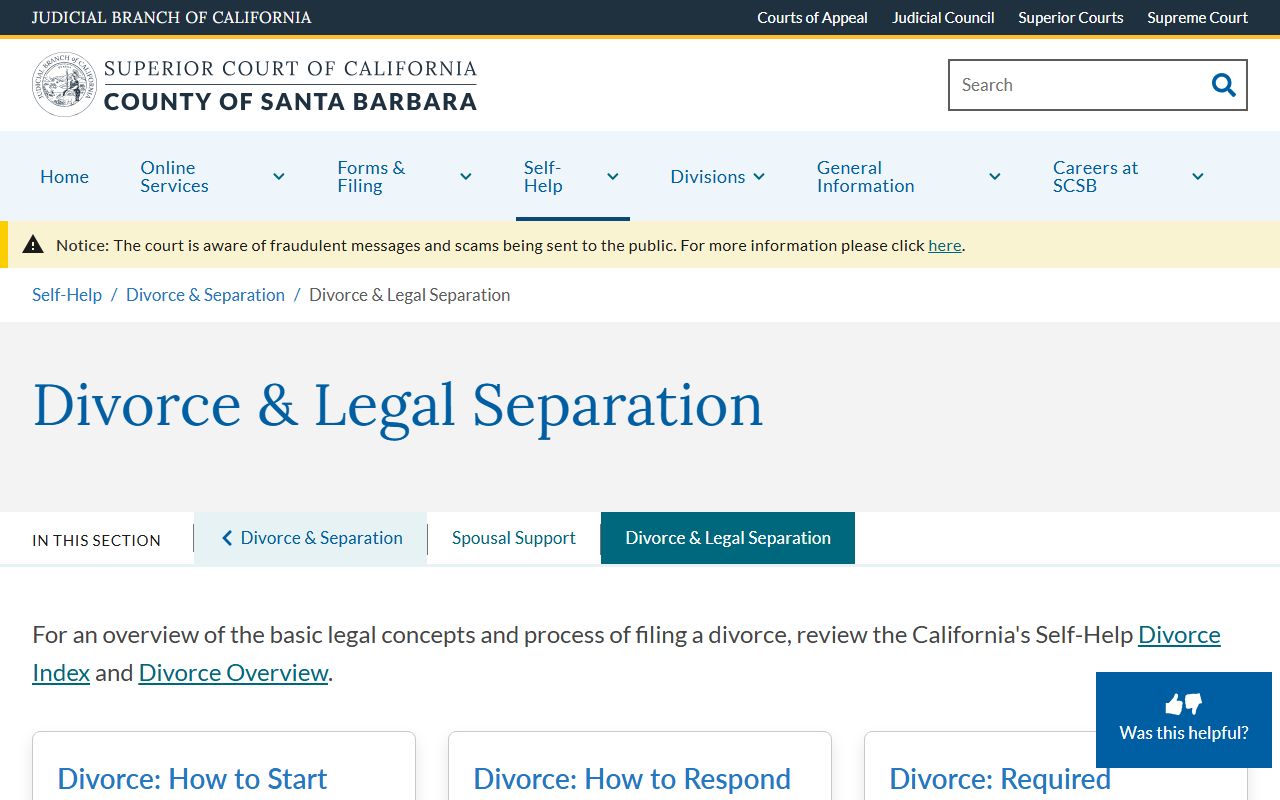
The page links to Judicial Council forms, the court's local family forms, and the Family Court Services unit, which handles mediation and parenting plans in custody cases.
Getting a Certified Divorce Judgment
Banks, lenders, name-change clerks, and immigration officers usually ask for a certified copy of the divorce judgment, not a print from the online portal. The Superior Court charges $15 for the certification and $0.50 per page for the judgment, under Government Code sections 70674 and 70627. The court cannot email a certified copy. A certified copy has to be picked up in person or mailed.
Use the court's records request method. Fill out the records request form, include the case number if you have it, pick a pickup or mail option, and send payment as the court instructs. The court warns the public not to send credit card data by email or phone. For mail, send a self-addressed stamped envelope. If you skip the envelope, the court adds postage to the bill.
Family Court Services and Self-Help
Family Court Services is the court's mediation arm for custody and visitation. The unit handles child custody recommending counseling, parent education, and the PEACE Online and PEACE en linea classes. Parents in a divorce or custody case may be sent to Family Court Services for a mediation session before a custody hearing. The court site lists the unit's intake methods and class schedule on the family pages.
Anyone filing a divorce without an attorney can use the court's self-help page and the California Courts self-help center. Filers can also drop in on a self-help clinic at the courthouse, where staff can explain how forms move through the case but cannot give legal advice.
Note: a certified copy of a divorce judgment cannot be sent by email; the court mails it or holds it for pickup at the records counter.